

Can a Non-Technical Student Become a Data Analyst?
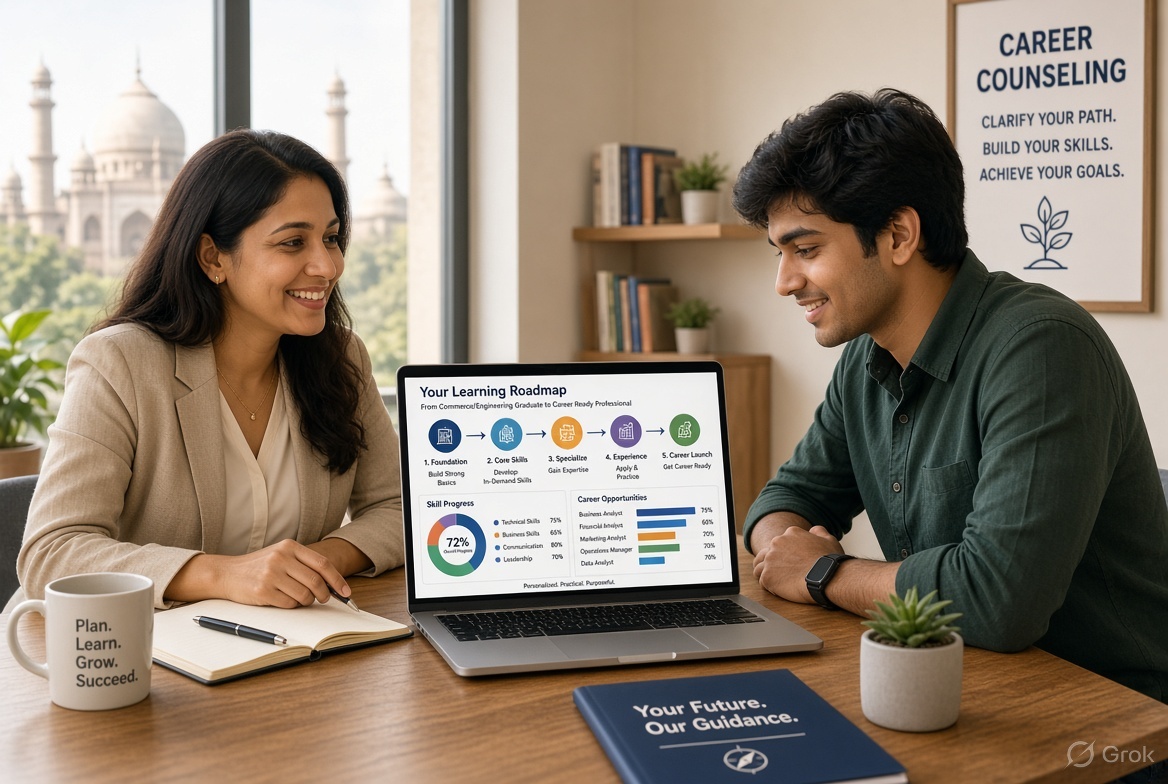
Introduction
“I am from a B.Com background. Can I still become a Data Analyst?”
“I am completely non-technical and have zero coding experience. Is this field for me?”
If you’re a student in Agra and wondering whether you can build a career in Data Analytics even if you’re non-technical, this post will help you understand that you are not the only one. Every month, thousands of students pursuing BCA, B.Tech, BBA, B.Com, and Arts from Agra and the surrounding areas check whether it is possible to pursue a career in Data Analytics as a non-technical individual.
The short answer is yes — and this article will show you exactly how, step by step, without hype or false promises.
Many students assume Data Analytics is only for engineers or computer science graduates. This is one of the biggest myths in the career space today. In reality, some of the strongest Data Analysts come from commerce, business, economics, and even humanities backgrounds — because they understand business problems well and simply learn the technical tools on top of that understanding.
What does non-technical actually mean? What skills do we actually need? And how will it be possible for students from Agra without any programming background to build their career in Data Analytics in 2026?
Why Data Analytics and Data Science Matter in 2026
Every business today — from a small retail shop to a large e-commerce company — collects data. Sales numbers, customer behaviour, website visits, marketing performance, and inventory levels are all recorded digitally.
The problem most companies face isn’t a lack of data. It’s a lack of people who can read that data and turn it into decisions.
That’s exactly what a Data Analyst does:
- Collects and organizes raw data
- Cleans messy, inconsistent information
- Analyzes patterns and trends
- Presents findings through charts, dashboards, and reports
- Helps managers and business owners make informed decisions
With AI tools now assisting with much of the repetitive technical work, the real value has shifted toward people who can ask the right questions, interpret results correctly, and communicate insights clearly — skills that don’t require a computer science degree to build.
This is exactly why Data Analytics is becoming one of the most accessible tech-adjacent careers for non-technical students in cities like Agra.
What Does “Non-Technical” Actually Mean?
Before going further, it’s important to clear up a common confusion.
You Might Think You Are “Non-Technical” If… | But This Doesn’t Stop You From Becoming a Data Analyst |
You studied B.Com, BBA, or Arts | These backgrounds give you strong business understanding, which is a huge advantage |
You’ve never coded before | SQL and Python for Data Analytics are far simpler than software development coding |
You’re not from an engineering college in Agra | Most working Data Analysts today learned skills through short-term training, not just degrees |
You’re comfortable with Excel but nothing else | Excel is actually the strongest foundation for Data Analytics |
Being “non-technical” simply means you haven’t learned these tools yet — not that you’re incapable of learning them.
Skills a Non-Technical Student Needs to Learn
Here is a realistic roadmap broken into categories, ordered by how beginner-friendly each skill is.
Foundation Skills (Start Here — No Coding Required)
- Excel – formulas, pivot tables, VLOOKUP, basic dashboards
- Basic Mathematics & Statistics – averages, percentages, probability basics, correlation
- Data understanding – learning what rows, columns, and datasets actually represent
Technical Skills (Learn Gradually)
- SQL – used to pull and organize data from databases; considered one of the easiest technical languages to learn
- Python for Data Analysis – primarily using libraries like Pandas; far less complex than software development Python
- Data cleaning – identifying errors, duplicates, and missing values in datasets
Business Intelligence Tools
- Power BI – visual, drag-and-drop dashboard building; very approachable for non-technical learners
- Tableau – similar visualization tool used widely in the industry
Modern Skills (2026 Focus)
- AI tools for data tasks – using AI to speed up analysis and reporting
- Prompting for data queries – asking AI tools the right questions to get useful outputs
- Basic automation – reducing repetitive manual work
Key takeaway: You do not need to learn all of this at once. Most successful Data Analysts start with Excel, move to SQL, then Power BI, and only later touch Python.
Step-by-Step Roadmap for Non-Technical Students
Step 1: Understand what Data Analytics actually involves (job roles, daily tasks, industries)
Step 2: Master Excel thoroughly — this alone can open entry-level opportunities
Step 3: Learn SQL for querying and organizing data
Step 4: Learn Power BI or Tableau to visualize data and build dashboards
Step 5: Gradually introduce Python for deeper analysis
Step 6: Practice on real datasets, not just tutorials
Step 7: Build 3–4 small projects using real-world business scenarios
Step 8: Create a portfolio showcasing your projects
Step 9: Prepare for interviews by practicing case studies and business scenarios
This roadmap is designed so a student can move from zero technical background to job-ready skills in a structured, non-overwhelming way.
Real-World Example: How a Non-Technical Analyst Might Work
Imagine a local retail business in Agra wants to understand why sales dropped last quarter.
A Data Analyst — even one from a commerce background — would approach it like this:
- Excel: Organize raw sales data by product, date, and region
- SQL: Pull relevant sales and customer records from the company database
- Data Cleaning: Remove duplicate entries and fix incorrect date formats
- Power BI: Build a dashboard showing sales trends by month and product category
- Analysis: Identify that sales dropped mainly in one product category during a specific festival period
- AI Tools: Use an AI assistant to quickly summarize findings into a report for management
Notice that none of this requires software engineering skills. It requires logical thinking, business awareness, and tool proficiency — all learnable skills.
Common Mistakes Non-Technical Students Make
- Trying to learn Python before Excel and SQL. Solution: Build your foundation first. Python becomes much easier once you understand data logic through Excel and SQL.
- Believing coding fear equals inability. Solution: SQL and beginner Python are query-based, not app-development coding. The learning curve is much gentler than students assume.
- Only watching tutorials without practicing. Solution: Apply every concept on a real or sample dataset immediately after learning it.
- Ignoring statistics completely. Solution: Even basic statistics knowledge dramatically improves the quality of your analysis and interview performance.
- Collecting certificates instead of building projects. Solution: Employers care more about what you can demonstrate than how many certificates you hold.
- Not learning to communicate insights. Solution: Practice explaining your findings in simple business language — this is often more valuable than technical depth.
- Comparing your speed to engineering students. Solution: Your pace will be different, and that’s completely fine. Business understanding often compensates for a slower technical start.
Learning Python before Excel and SQL : . You have to take the basic steps before you can jump the higher steps. Learning data logic in Excel and SQL will actually help make learning Python easier.
Believing coding fear equals inability : Learning both beginner SQL and basic Python will not involve any type of application development. The learning curve is typically much easier than what is expected.
Only watching tutorials without practicing.. Every single concept that you learn should be applied to a real world or made up dataset.
Ignoring statistics completely : A little bit of statistics will actually make all the difference in the quality of your analysis and performance in interviews.
Collecting certificates instead of building projects. Employers see more of what you show than what you hold.
Not learning to communicate insights.. Communicating your findings should be your new focus.
Comparing yourself to engineering students. Your pace will be different, but so what? A lot of people gain a good understanding of business to compensate in the early stages,
Career Opportunities for Non-Technical Students
Once foundational and technical skills are developed, students can explore roles such as:
- Data Analyst
- Business Analyst
- BI (Business Intelligence) Analyst
- Junior Data Analyst
- Reporting Analyst
- Product Analyst
- Marketing Data Analyst
The exact opportunities available will depend on your skill level, project portfolio, internship experience, and the specific job market at the time — but the entry barrier for non-technical students is far lower than most people assume.
Where Students in Agra Can Build These Skills
Learning Data Analytics as a non-technical student works best with structured guidance rather than scattered YouTube tutorials, especially when it comes to knowing what to learn first and how to practice on real datasets.
Students looking for structured Data Analytics training in Agra can also explore practical learning opportunities at NDMIT, where the focus can be placed on developing job-relevant skills such as Excel, SQL, Python, and Power BI through hands-on projects and real-world datasets. This kind of guided, project-based learning can be especially helpful for students coming from non-technical backgrounds who want a clear starting point.
Conclusion
Being a non-technical student is not a disadvantage in Data Analytics — it’s simply a different starting point. With the right roadmap, consistent practice, and a focus on practical projects rather than just theory, students from B.Com, BBA, BCA, and other backgrounds in Agra can absolutely build a successful career in this field.
Start with Excel. Move to SQL. Add Power BI. Practice on real data. Build a portfolio. Take it one skill at a time.
If you’re looking for structured, practical guidance to begin this journey, exploring a Data Analytics training program in Agra through NDMIT can be a useful next step toward building job-relevant, hands-on skills.
End-of-blog CTA (main):
Ready to turn this roadmap into real skills? Explore the Data Analytics training program at NDMIT in Agra and start building job-relevant skills with hands-on projects on real datasets.
👉 [Learn More About the Data Analytics Course at NDMIT]
Frequently Asked Questions
Yes. Many successful Data Analysts come from commerce, business, and arts backgrounds. Technical skills like SQL, Excel, and Power BI can be learned step by step regardless of your degree
No prior coding knowledge is required. Most beginners start with Excel and SQL, which are far simpler than software development coding, before gradually moving to Python.
Start with Excel, followed by basic statistics, then SQL. These form the foundation before moving on to Power BI, Tableau, and Python.
Yes. As more businesses rely on data for decision-making, demand for skilled Data Analysts continues to grow across industries, including in cities like Agra.
Students can begin with free resources for fundamentals and then move to structured, project-based training programs, such as those offered at NDMIT in Agra, to build job-relevant skills.
This varies by individual effort and consistency, but with focused learning and regular practice on real datasets, students can build a foundational skill set and portfolio over a few months.
Most educators recommend learning SQL before Python, since SQL is more intuitive for beginners and directly relevant to how businesses store and access data.
📊 “But I’m not from a technical background…” — Sound familiar?
Here’s the truth: Non-technical students in Agra ARE becoming Data Analysts every day. No coding background? No problem. Start with Excel, add SQL, and build from there. 💡
Planning Your Visit?
Whether you’re coming from Khandari, Bhagwan Talkies, Kamla Nagar, Dayal Bagh, or even nearby cities like Mathura or Firozabad, finding NDMIT Agra is simple. Save the location, check reviews and photos on our Google Business Profile, and get direct navigation whenever you’re ready.
[Get Direct Driving Directions to NDMIT Agra on Google Maps →] NDMIT Agra
Table of Contents
Let's Grow Your Business
- More visibility on Google
- Get cited on ChatGPT, Claude and others
- Thumb-stopping content across social
- High-converting paid media campaings
- Smarter email with stronger retention
Do you want more traffic?
Hey, We Are NDMIT. We Are determined to make a business grow. Our only question is, will it be yours?